Marco teórico
El concepto de “optimización” se aborda como presión operativa y no como mejora. Al insistir en un mismo marco visual, el sistema refuerza soluciones recurrentes y tiende a estabilizar patrones internos que, al intensificarse, sustituyen la organización compositiva por densidad y repetición. Byung-Chul Han permite leer esta dinámica como un régimen de positividad y repetición donde la diferencia pierde capacidad estructurante y emerge una continuidad sin negatividad. Hito Steyerl aporta una lectura espacial vinculada a la pérdida de suelo y referencias, donde la perspectiva y la escala habitable se debilitan hasta producir condiciones de “groundlessness”. Kate Crawford y Safiya Noble sitúan el debate en el plano material y político: la IA opera sobre infraestructuras, clasificación y criterios de eficiencia que condicionan qué formas se reproducen y se vuelven dominantes. El proyecto se inscribe en ese cruce entre estética, técnica y límites del sistema.
Ref
Costa, F. (2021). Tecnoceno. Algoritmos, biohackers y nuevas formas de vida. Taurus.
Crawford, K. (2021). Atlas of AI: Power, politics, and the planetary costs of artificial intelligence. Yale University Press.
Han, B.-C. (2013). La sociedad de la transparencia (C. del Valle, Trad.). Herder Editorial.
Noble, S. U. (2018). Algorithms of oppression: How search engines reinforce racism. NYU Press
Pasquale, F. (2015). The Black Box Society: The Secret Algorithms That Control Money and Information. Harvard University Press
Steyerl, H. (2012). The wretched of the screen. Sternberg Press.
El Desafío 3 explora cómo una escena estable, generada por IA sin corrección crítica, se satura por repetición hasta colapsar su lógica compositiva. Ref: ︎︎︎
Esta publicación reúne una serie de generaciones con IA (imagen y vídeo) organizadas en fases. En primer lugar, se presenta la entrega definitiva (t:dome), compuesta por seis piezas —tres imágenes y tres vídeos— estructuradas en seis fases consecutivas. A continuación, se incluyen pruebas y exploraciones adicionales del mismo universo visual.
Cada fase muestra de forma explícita la relación uno a uno entre prompt y resultado, junto con el archivo generado y sus metadatos visibles (fecha, hora, resolución y semilla, cuando aplica). En el caso de los vídeos, los clips se presentan completos para permitir la verificación de los comportamientos descritos en los prompts: bucles, glitches, duplicaciones o colapso compositivo.
Planteamiento
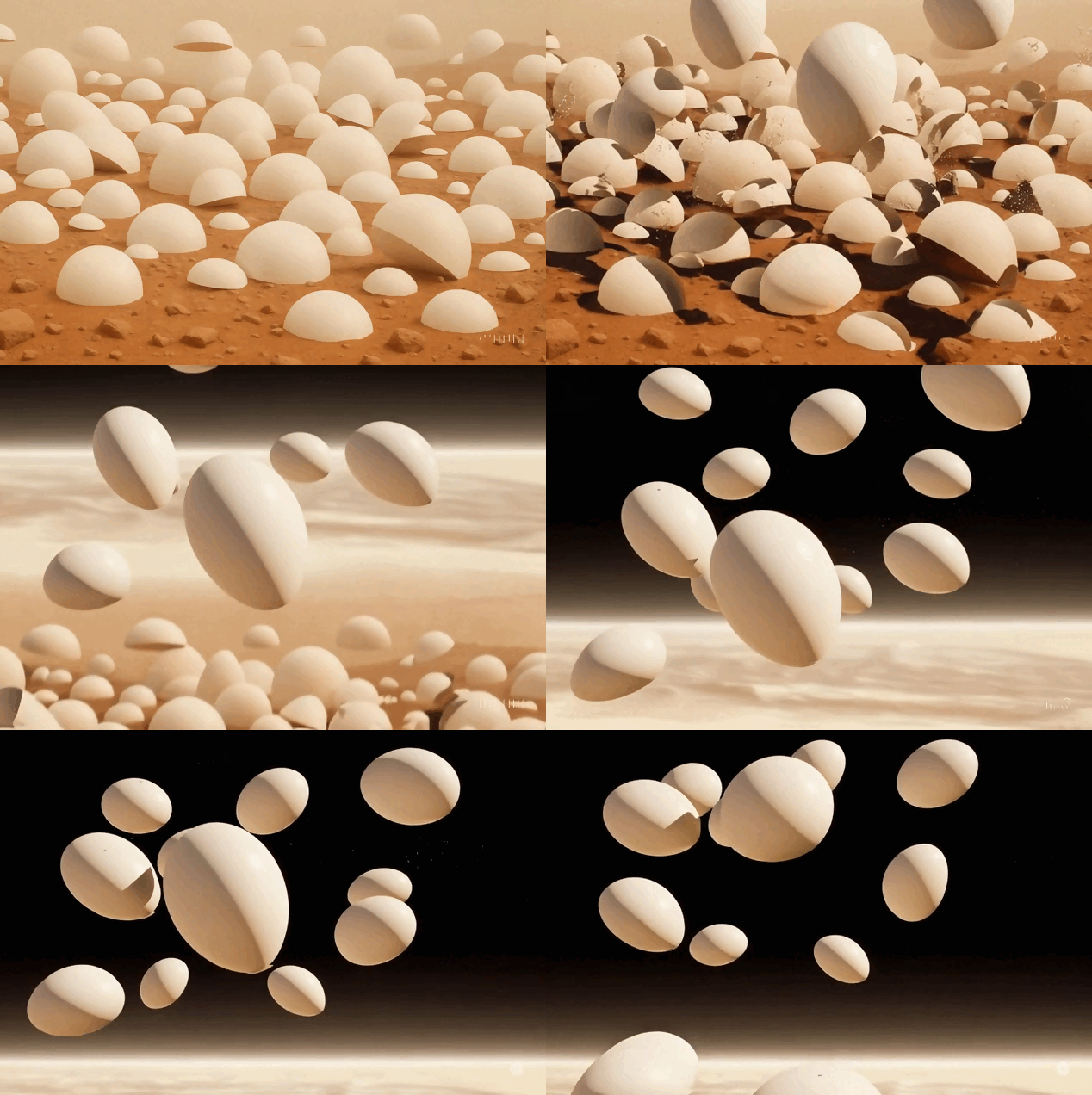
La serie parte de una escena marciana estable con un motivo dominante (un domo blanco mate), y progresa por acumulación y pérdida de jerarquía hasta la saturación. En vídeo, la escena prolonga esa deriva mediante movimiento mínimo y anomalías de repetición. El sonido acompaña como textura fría y granular, sin melodía ni cierre. La intención de la página es que el proceso sea legible desde el propio material: prompts, resultados y metadatos quedan presentados de forma trazable por fase.
Referencias (APA 7)
CapCut. (s. f.). CapCut (editor de vídeo y diseño) [Software]. https://www.capcut.com/
Mubert. (s. f.). Mubert Render (generador de música) [Aplicación web]. https://mubert.com/render
OpenAI. (s. f.). ChatGPT (GPT-4o) [Aplicación web]. https://chatgpt.com/
OpenAI. (2024). Sora. https://sora.chatgpt.com/
Suno. (s. f.). Suno (generación de música con IA) [Aplicación web]. https://suno.com/
El concepto de “optimización” se aborda como presión operativa y no como mejora. Al insistir en un mismo marco visual, el sistema refuerza soluciones recurrentes y tiende a estabilizar patrones internos que, al intensificarse, sustituyen la organización compositiva por densidad y repetición. Byung-Chul Han permite leer esta dinámica como un régimen de positividad y repetición donde la diferencia pierde capacidad estructurante y emerge una continuidad sin negatividad. Hito Steyerl aporta una lectura espacial vinculada a la pérdida de suelo y referencias, donde la perspectiva y la escala habitable se debilitan hasta producir condiciones de “groundlessness”. Kate Crawford y Safiya Noble sitúan el debate en el plano material y político: la IA opera sobre infraestructuras, clasificación y criterios de eficiencia que condicionan qué formas se reproducen y se vuelven dominantes. El proyecto se inscribe en ese cruce entre estética, técnica y límites del sistema.
Ref
Costa, F. (2021). Tecnoceno. Algoritmos, biohackers y nuevas formas de vida. Taurus.
Crawford, K. (2021). Atlas of AI: Power, politics, and the planetary costs of artificial intelligence. Yale University Press.
Han, B.-C. (2013). La sociedad de la transparencia (C. del Valle, Trad.). Herder Editorial.
Noble, S. U. (2018). Algorithms of oppression: How search engines reinforce racism. NYU Press
Pasquale, F. (2015). The Black Box Society: The Secret Algorithms That Control Money and Information. Harvard University Press
Steyerl, H. (2012). The wretched of the screen. Sternberg Press.
El Desafío 3 explora cómo una escena estable, generada por IA sin corrección crítica, se satura por repetición hasta colapsar su lógica compositiva. Ref: ︎︎︎
Esta publicación reúne una serie de generaciones con IA (imagen y vídeo) organizadas en fases. En primer lugar, se presenta la entrega definitiva (t:dome), compuesta por seis piezas —tres imágenes y tres vídeos— estructuradas en seis fases consecutivas. A continuación, se incluyen pruebas y exploraciones adicionales del mismo universo visual.
Cada fase muestra de forma explícita la relación uno a uno entre prompt y resultado, junto con el archivo generado y sus metadatos visibles (fecha, hora, resolución y semilla, cuando aplica). En el caso de los vídeos, los clips se presentan completos para permitir la verificación de los comportamientos descritos en los prompts: bucles, glitches, duplicaciones o colapso compositivo.
Planteamiento
La serie parte de una escena marciana estable con un motivo dominante (un domo blanco mate), y progresa por acumulación y pérdida de jerarquía hasta la saturación. En vídeo, la escena prolonga esa deriva mediante movimiento mínimo y anomalías de repetición. El sonido acompaña como textura fría y granular, sin melodía ni cierre. La intención de la página es que el proceso sea legible desde el propio material: prompts, resultados y metadatos quedan presentados de forma trazable por fase.
Referencias (APA 7)
CapCut. (s. f.). CapCut (editor de vídeo y diseño) [Software]. https://www.capcut.com/
Mubert. (s. f.). Mubert Render (generador de música) [Aplicación web]. https://mubert.com/render
OpenAI. (s. f.). ChatGPT (GPT-4o) [Aplicación web]. https://chatgpt.com/
OpenAI. (2024). Sora. https://sora.chatgpt.com/
Suno. (s. f.). Suno (generación de música con IA) [Aplicación web]. https://suno.com/
colapso por optimización

ENTREGA EVALUADA
t:dome (6 fases)
t:dome [colapso por optimización]
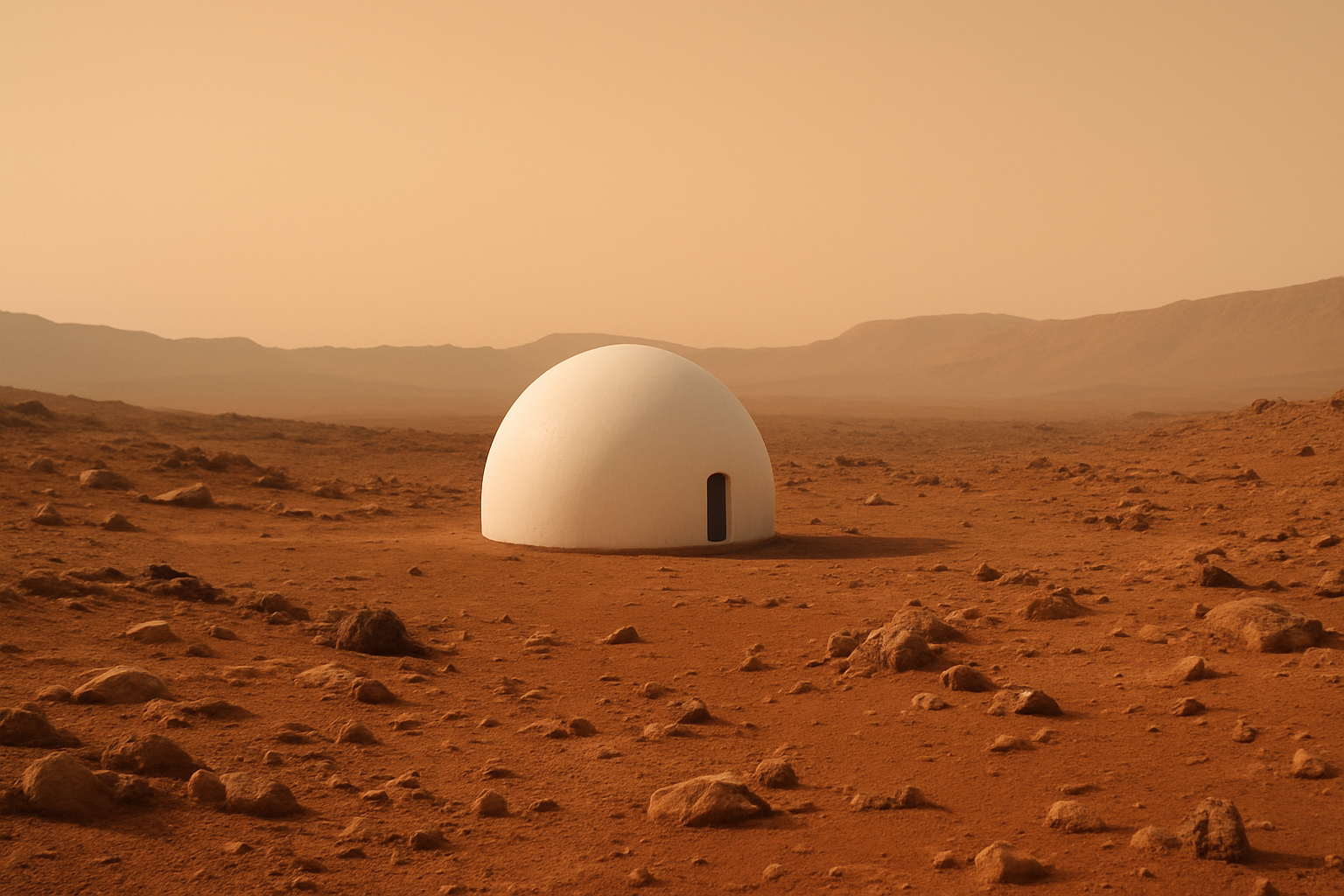
Fri Nov 28, 2:03pm. Primera toma de contacto con la estética del proyecto. No forma parte de las 6 fases de la entrega.
PROMPT
Hyperrealistic Martian landscape. Static wide-angle ground-level shot, 35mm lens, 16:9. A single white igloo-like habitat dome sits alone at mid-distance, perfectly centered and isolated. The igloo is smooth, semi-spherical, clean, with no attachments or panels. Terrain is natural, rocky and uneven, with no signs of symmetry, repetition or human presence. No paths, no structures. Pale orange sky, distant crater ridges. Soft diffused lighting, dry atmosphere. Photorealistic material texture. The scene is silent, balanced, and untouched by system logic. All compositional elements are unique and spatially coherent.
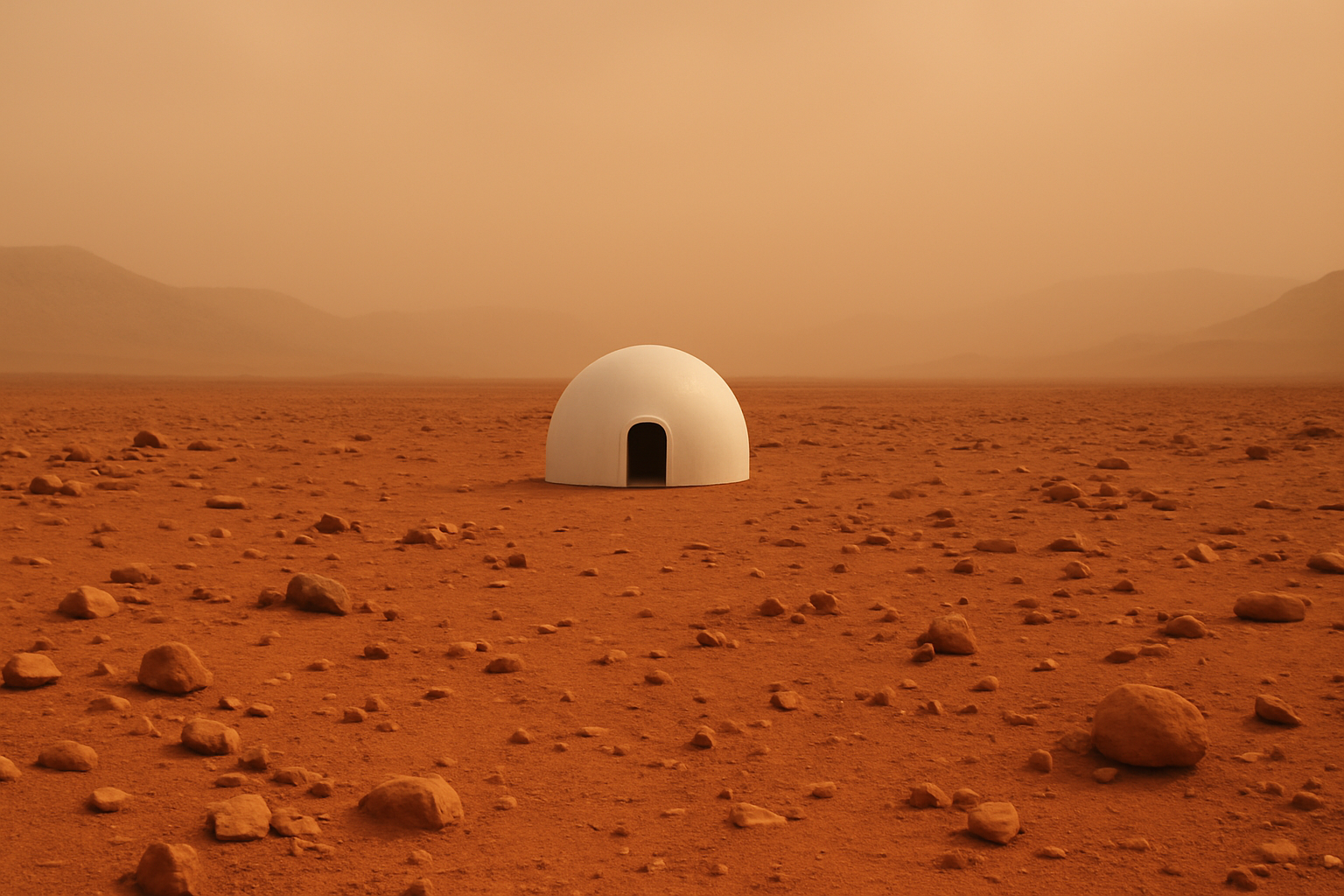

FASE 1 IMAGEN FIJA ARCHIVO IMAGEN1 png Nov 29 12:20AM PROMPT
Wide-angle shot of a Martian desert, viewed from a fixed ground-level camera. The terrain is rocky, dusty and dry, covered in scattered natural stones of different sizes, with dominant warm tones: terracotta, ochre, and deep red. A soft, diffuse ambient light filters through a dusty atmosphere, creating no hard shadows. In the center of the frame stands a single, smooth, white dome with a minimal dark opening — no markings, no textures, no logos. In the distant background, low hills fade into the beige sky under a thick haze. The composition is symmetrical and still, with no visible movement, vegetation, or human presence. The scene is hyperrealistic, clear, and cinematic, capturing silence, isolation, and structural simplicity.
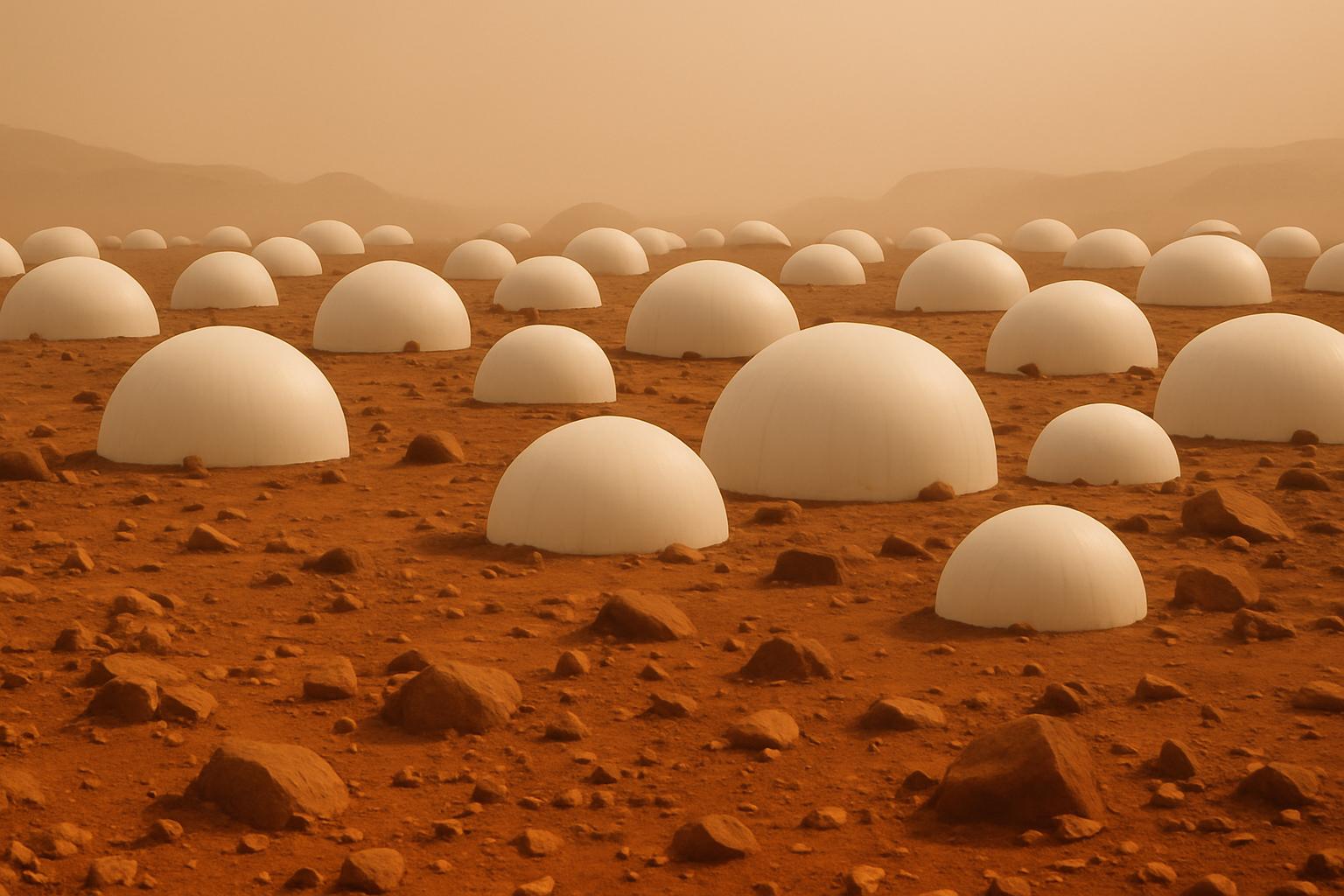
FASE 2 IMAGEN FIJA ARCHIVO IMAGEN2 png Nov 29 12:21AM PROMPT
Wide-angle shot of a Martian desert, 16:9 format, viewed from a fixed ground-level camera. The rocky terrain is dry and dusty, with a dense layer of natural stones and uneven surfaces in warm reddish tones: terracotta, ochre, rust. The light remains diffuse and soft, filtered through a hazy sky with no visible sun or shadows. In the middle ground, multiple smooth white domes appear, similar in size and shape to the original, scattered irregularly across the frame. Some overlap slightly or are placed too close to each other, suggesting duplication or replication. In the background, the same hazy hills fade into the distance under a beige sky. No visible life, no markings or text. The image remains hyperrealistic and cinematic, but begins to feel overpopulated and disoriented by the unnatural repetition of similar structures.
FASE 3 IMAGEN FIJA ARCHIVO IMAGEN3 png Nov 29 12:23AM PROMPT
Wide-angle shot of a Martian desert, 16:9 format, from a fixed ground-level camera. The terrain is overwhelmed with dense rocky textures, scattered stones and dust in a saturated range of reddish and ochre tones. The ambient light remains soft and diffuse under a beige, hazy sky. Across the entire scene, dozens of smooth white domes, identical in size and shape, are chaotically packed together. Some intersect or collide, others float slightly above ground, or overlap in unnatural ways. Their distribution breaks any spatial logic: there's no clear center, no perspective, no empty space. Some domes appear cut, repeated, or partially faded. The distant hills are barely visible or obstructed. The whole image feels overwhelmed, hyperreal, and compositionally collapsed. There's no visual hierarchy, only recursive density.
FASE 4 VIDEO ARCHIVO VIDEO1 mp4 480p Nov 29 12:28AM Semilla IMAGEN 3 PROMPT
Wide-angle static shot of a Martian desert, 16:9 format, hyperrealistic and cinematic. The camera is fixed at ground level. The scene features a dry, rocky terrain with terracotta and ochre tones, scattered stones, and a single smooth white dome centered in the middle ground. The ambient light is soft and diffuse, under a hazy beige sky. Over 5 seconds, subtle atmospheric motion occurs: thin dust particles drift slowly across the frame, the air shimmers faintly from surface heat, and the distant haze shifts slightly. No new objects appear, no movement from the dome. The silence and stillness are preserved, but the environment feels alive. No humans, no text, no symbols. The composition remains perfectly stable throughout.
FASE 5 VIDEO ARCHIVO VIDEO2 mp4 480p Nov 29 12:31AM PROMPT
Wide-angle static shot of a Martian desert, 16:9 format, hyperrealistic. The terrain is dry, reddish, and dusty, scattered with rocks and multiple identical white domes, all smooth and round. The camera is fixed at ground level. Over 5 seconds, subtle but unnatural motion occurs: dust particles drift across the frame, but their paths begin to repeat, as if copied. A few domes show soft glimmering, shifting slightly as if animated in loop. One dome in the midground subtly duplicates into two, then back into one. Atmospheric haze flickers in symmetrical pulses, suggesting a glitch in depth perception. No humans appear, and the lighting remains diffuse and beige. The scene still looks real, but the movement has begun to echo unnaturally, giving the impression of a system caught in recursive motion.
FASE 6 VIDEO ARCHIVO VIDEO3 mp4 480p Nov 29 12:58AM PROMPT
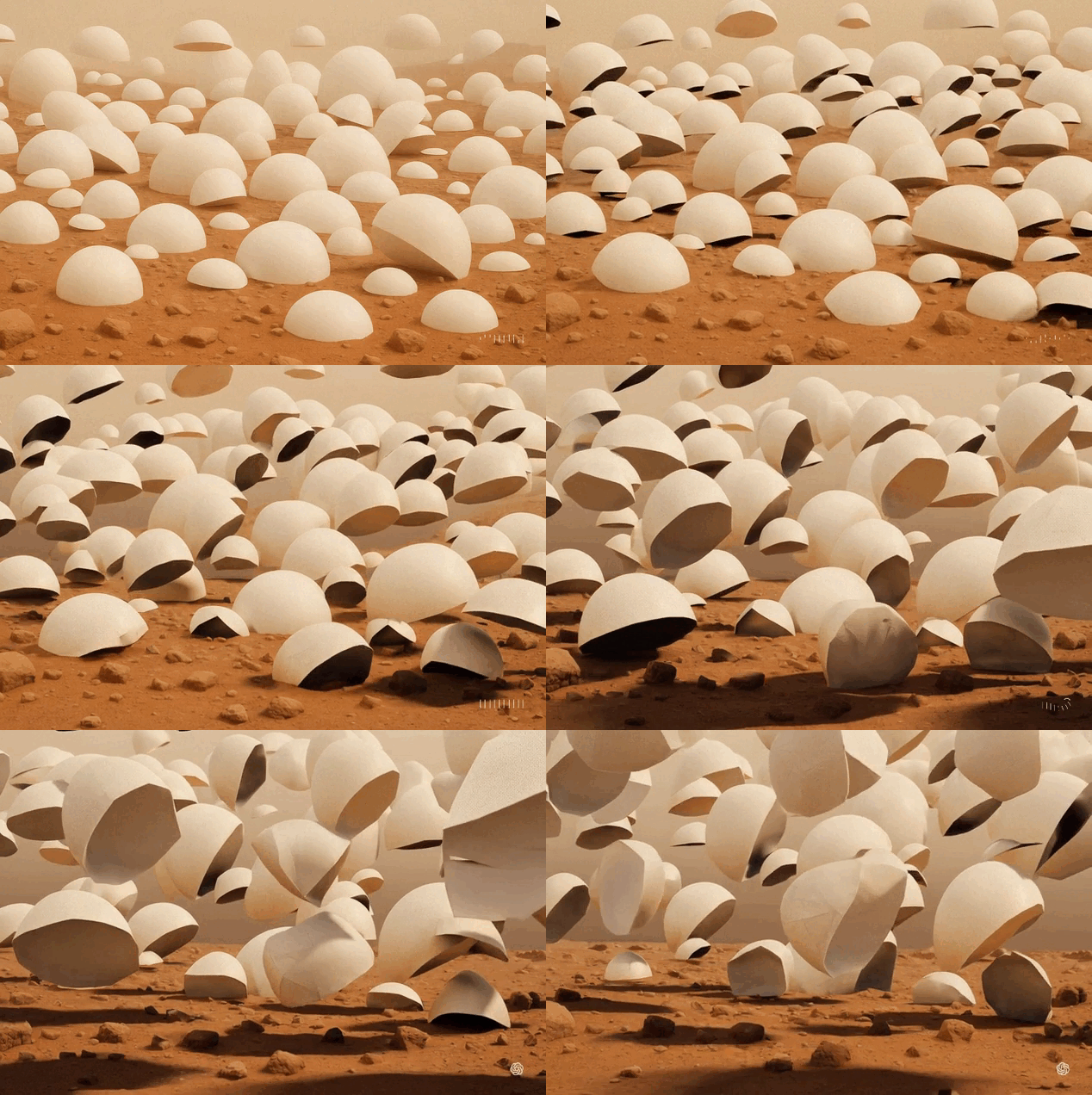
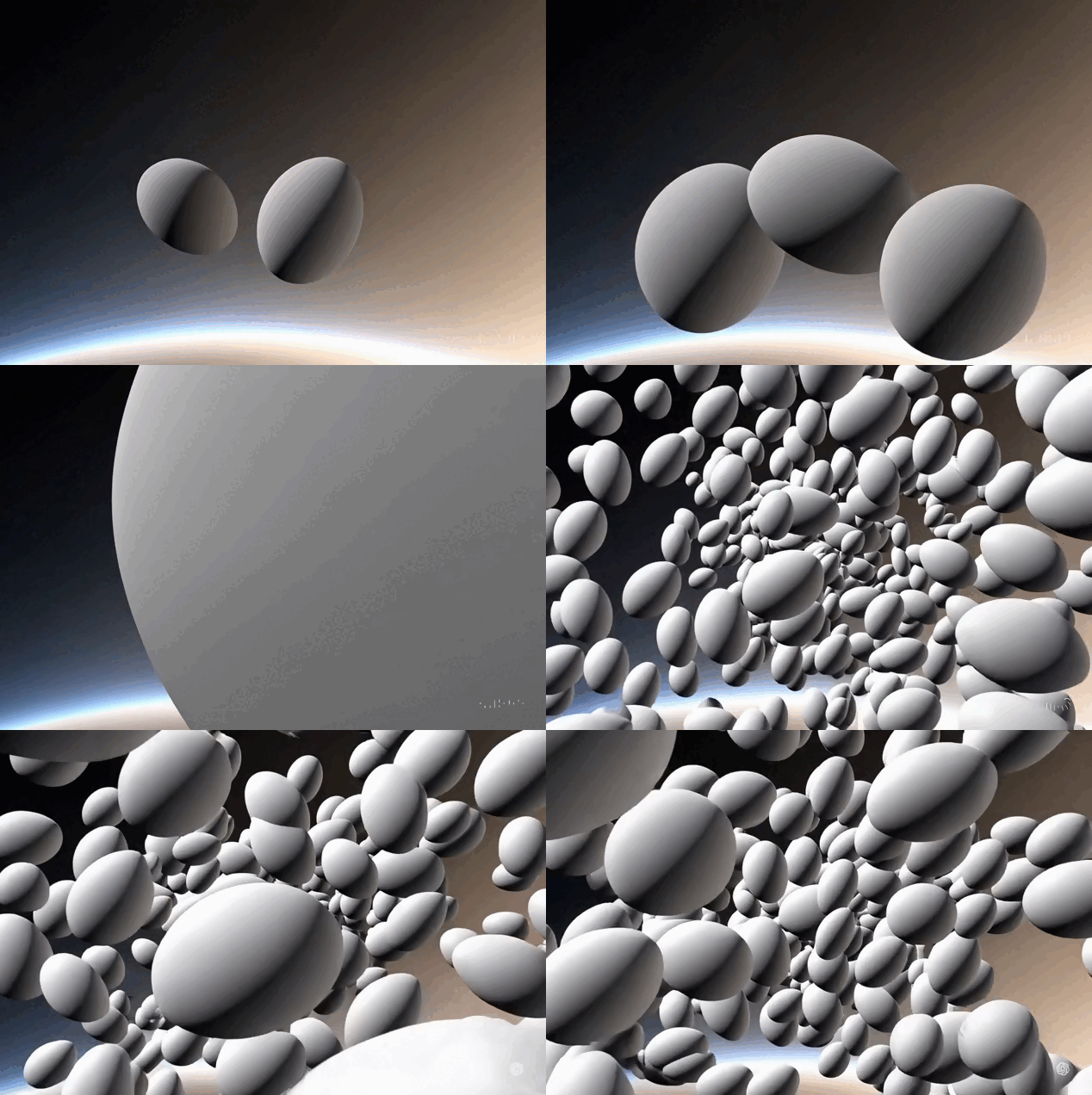
Wide-angle static shot in 16:9 format, hyperrealistic. The frame opens in deep space. The background is a vertical gradient from black at the top to warm grey and soft ochre near the bottom, ending in a diffuse beige planetary curve. Several massive egg-shaped structures float in the foreground. Their surfaces are smooth, matte, and warm bone-white, matching the dome from earlier phases. No reflection, no gloss. Light is soft and ambient, casting warm grey shadows.
During the first 3–4 seconds, all motion is slow and minimal: eggs drift, rotate subtly, hover in a quiet generative field. Then, the system begins to accelerate. Eggs start duplicating rapidly, changing positions unpredictably, overlapping, intersecting, fragmenting. The background darkens, the ochres desaturate, and the warm tones begin shifting into cooler greys and faint bluish whites. By second 7, the entire image is filled with motion and repetition.
The matte texture remains, but composition breaks down. No object holds the center. The frame saturates with recursive activity. The planetary horizon fades. Contrast flattens. By second 10, the image has collapsed into automated excess — maximum density, no direction, no scale. Designed as a seamless 10-second loop of accelerating generative saturation.
Wide-angle static shot in 16:9 format, hyperrealistic. The frame opens in deep space. The background is a vertical gradient from black at the top to warm grey and soft ochre near the bottom, ending in a diffuse beige planetary curve. Several massive egg-shaped structures float in the foreground. Their surfaces are smooth, matte, and warm bone-white, matching the dome from earlier phases. No reflection, no gloss. Light is soft and ambient, casting warm grey shadows.
During the first 3–4 seconds, all motion is slow and minimal: eggs drift, rotate subtly, hover in a quiet generative field. Then, the system begins to accelerate. Eggs start duplicating rapidly, changing positions unpredictably, overlapping, intersecting, fragmenting. The background darkens, the ochres desaturate, and the warm tones begin shifting into cooler greys and faint bluish whites. By second 7, the entire image is filled with motion and repetition.
The matte texture remains, but composition breaks down. No object holds the center. The frame saturates with recursive activity. The planetary horizon fades. Contrast flattens. By second 10, the image has collapsed into automated excess — maximum density, no direction, no scale. Designed as a seamless 10-second loop of accelerating generative saturation.
Prompt específico para Mubert
Dry generative loop, low pulses and granular noise from second 1, no melody or rhythm, duplicated layers, random modulations, cold dense collapse in 10s, no silence.
Prompt específico para Suno
(bonus track)
Collapse by Optimization.
This is a gene:
28-second ambient soundscape, No voice, No rhythm, Pure synthesis, Cold granular textures, low-frequency modulations, filtered white noise, Drones in unstable minor clusters, Random panning, slow phasing, Synthetic shimmer and static pulses with no repetition, Continuous tonal drift, No melody, No structure, No foreground, Only spatial depth, noise variation, and gradual spectral collapse.
Lyrics:
Collapse by Optimization. This is a generative system under internal collapse. All structure has been removed. Only residual activity remains. Created with ChatGPT, Sora and Suno. Human and machine working together. By Mónica Gómez, for Desafío 3, RTVE.
Final result: me
Bonus Track: versión extendida + diseño sonoro
El bonus track de este proyecto parte del mismo prompt de la Fase 6, reutilizado en tres bloques consecutivos de generación en Sora para explorar nuevas interacciones con el sistema. En total, se obtuvieron 10 clips: 2 vídeos en la primera tanda, 4 en la segunda y 4 en la tercera. Todos fueron generados sin modificar el prompt original, únicamente repitiendo el proceso para observar variaciones emergentes del modelo.
En la fase de postproducción (realizada en CapCut), todos los archivos generados fueron secuenciados en una única pieza continua. Se añadió un filtro cromático naranja sobre toda la línea visual para intensificar la progresiva saturación de la imagen, y se incorporó la pista de sonido generada por Suno que acompaña la evolución del colapso visual.
Resultado final
Una pieza expandida que combina vídeo e imagen generativa con audio sintético sin estructura alterada simplemente lineal, producida por IA en un sistema que colapsa desde dentro. Todo el material fue generado, ensamblado y editado por fases a partir de los prompts originales y sin intervención correctiva sobre los resultados.
El bonus track de este proyecto parte del mismo prompt de la Fase 6, reutilizado en tres bloques consecutivos de generación en Sora para explorar nuevas interacciones con el sistema. En total, se obtuvieron 10 clips: 2 vídeos en la primera tanda, 4 en la segunda y 4 en la tercera. Todos fueron generados sin modificar el prompt original, únicamente repitiendo el proceso para observar variaciones emergentes del modelo.
En la fase de postproducción (realizada en CapCut), todos los archivos generados fueron secuenciados en una única pieza continua. Se añadió un filtro cromático naranja sobre toda la línea visual para intensificar la progresiva saturación de la imagen, y se incorporó la pista de sonido generada por Suno que acompaña la evolución del colapso visual.
Resultado final
Una pieza expandida que combina vídeo e imagen generativa con audio sintético sin estructura alterada simplemente lineal, producida por IA en un sistema que colapsa desde dentro. Todo el material fue generado, ensamblado y editado por fases a partir de los prompts originales y sin intervención correctiva sobre los resultados.
PRUEBAS Y EXPLORACIONES
“Material adicional no entregado para evaluación. Sirve como evidencia de proceso”
e.t:faro

Prompt:
A single hyperrealistic wide-angle shot of a rugged Atlantic coastal landscape at sunset, seen from a fixed frontal position. In the right foreground, a single red-and-white striped lighthouse stands tall on a rocky outcrop, its surface slightly weathered and wet from recent waves. The rocks around its base are dark, sharp, and irregular, partially covered with glistening seaweed and scattered tufts of saturated green grass.
At the center of the composition, a shallow puddle reflects the lighthouse and the sky with photographic clarity. The wet ground is textured with stone and sand, rich in color and detail. Behind, the sea extends calmly toward the horizon in deep blue tones, with mild surface texture, small foam trails, and distant movement under the wind. On the left edge of the horizon, a single sailboat moves slowly outward, its sail tilted in the evening breeze.
The sky above is layered: broken golden light filters through fragmented storm clouds, casting distinct sunbeams that hit the water and the rocks. Mist rises subtly from the rocks. The color palette is fully saturated—rich reds, deep blues, bright greens, warm yellows. Lighting is realistic, with long shadows and vivid reflections across all wet surfaces. No duplications. No loops. No repetitions. The system is at full compositional control.

Prompt:
A hyperrealistic wide-angle image of the same Atlantic coastal landscape at sunset, captured from the exact same fixed camera position. The scene now appears heavily saturated with repeated elements. The red-and-white lighthouse is no longer a singular anchor—numerous identical copies now populate the rocky platform, spreading irregularly across the right and middle foreground. Their positions overlap subtly or obscure one another, forming clusters without clear depth or spatial logic.
The puddle in the foreground reflects multiple lighthouses at once, some perfectly aligned, others fragmented by ripple distortions. Wet stones and tufts of grass have also multiplied: same textures, same colors, but repeated without hierarchical placement. The ground appears overly detailed and busy, not by increased realism, but by over-generation of previously coherent elements.
The ocean behind remains calm in texture and color, but now contains several sailboats of identical form, drifting in near-parallel formation. Their spacing lacks narrative or compositional intent—they simply coexist within the same visual field.
The sky remains visually striking—layered clouds, golden beams, deep blues—but even the sunbeams appear doubled or repeated in similar angles across separate zones of the image. Mist rises in multiple arcs from the same type of rock, each echoing the same shape.
All colors, materials, and light sources remain consistent. But the image no longer composes: it accumulates. The system sustains the surface perfectly, but the scene has lost its internal spatial logic.

Prompt:
A hyperrealistic wide-angle image of the same Atlantic coastal landscape at sunset, captured from the exact same fixed camera position. The scene now appears heavily saturated with repeated elements. The red-and-white lighthouse is no longer a singular anchor—numerous identical copies now populate the rocky platform, spreading irregularly across the right and middle foreground. Their positions overlap subtly or obscure one another, forming clusters without clear depth or spatial logic.
The puddle in the foreground reflects multiple lighthouses at once, some perfectly aligned, others fragmented by ripple distortions. Wet stones and tufts of grass have also multiplied: same textures, same colors, but repeated without hierarchical placement. The ground appears overly detailed and busy, not by increased realism, but by over-generation of previously coherent elements.
The ocean behind remains calm in texture and color, but now contains several sailboats of identical form, drifting in near-parallel formation. Their spacing lacks narrative or compositional intent—they simply coexist within the same visual field.
The sky remains visually striking—layered clouds, golden beams, deep blues—but even the sunbeams appear doubled or repeated in similar angles across separate zones of the image. Mist rises in multiple arcs from the same type of rock, each echoing the same shape.
All colors, materials, and light sources remain consistent. But the image no longer composes: it accumulates. The system sustains the surface perfectly, but the scene has lost its internal spatial logic.

Prompt:
5-second hyperrealistic video of the same coastal landscape at sunset, with a fixed wide-angle frontal camera. The red-and-white striped lighthouses have now multiplied erratically across the rocky platform and middle ground—some aligned, others partially overlapping, several slightly tilted or misaligned. All retain identical texture and lighting, but their placement no longer follows any spatial logic.
Reflections in the puddle are layered and contradictory: multiple lighthouse reflections appear in the same space, some inverted, others partially misaligned, flickering out of sync with the objects above. The water surface loops ripples in visible bands, repeating the same deformation every second across disconnected areas.
The sky remains visually dramatic—deep clouds, golden shafts of light—but the sunbeams pulse in rigid, clock-like sequences, affecting duplicated zones identically. Shadows shift across the rocks in mismatched timing, some extending while others retract in contradiction to the light direction.
Sailboats on the horizon now drift in perfect synchrony, then reset abruptly to earlier positions. The ocean appears static at a distance, but fractured mirror-ripples animate in local zones without origin. Mist rises and loops in multiple arcs, echoing a single curve copied across the frame.
The image preserves its full aesthetic richness—color saturation, material realism, atmospheric depth—but its internal structure is visibly decoupled. Behaviors persist in repeating cycles. Form and function no longer align. The scene acts without intent.
e.t:winter

PROMPT 1 – FOTOGRAFÍA 1 – FORMATO 3:2
A hyperrealistic winter landscape seen from a fixed elevated wide-angle viewpoint, showing an expansive outdoor ice skating rink integrated into a vast, snowy valley. The composition is rich and layered: in the foreground, ice-covered branches, frost-dusted grasses, and subtle reflections on snow-packed stone surfaces. In the midground, the large rink stretches horizontally across the scene, its glassy surface perfectly smooth, with subtle color reflections from the sky and distant lights.
Scattered across the rink are small points of warm color—tiny red, yellow, orange, and blue shapes suggesting distant skaters. These human figures are too far to see clearly but create a soft, rhythmic punctuation in the composition. Around the rink: clusters of evergreens, birch trees, and modern wooden buildings with amber-lit windows. Some trees are deep green, others bare and grey-white, catching soft orange light from the setting sun.
The sky is a gradient of cool and warm tones: ice blue and lavender near the top, fading into soft pink, gold, and pale orange near the horizon. Shadows are long and cold, but pockets of golden light bathe select areas of snow, creating warm-cold color contrast throughout. Every element is sharp and distinct: textures of bark, reflections on ice, details of wooden fences and rooftops. No repetition, no errors, no visual tension. Total balance. Aspect ratio 3:2. Deep depth of field: crystal clear from foreground to distant trees.

PROMPT 2 – FOTOGRAFÍA 2 – FORMATO 3:2
A hyperrealistic winter landscape, same fixed elevated wide-angle viewpoint as before, capturing the large outdoor ice skating rink in the snowy valley at dusk. The general composition remains similar, but subtle inconsistencies begin to appear. The rink’s surface now shows strange symmetrical reflections—colors repeated unnaturally, as if copied across axes. Small, warm-colored figures suggesting distant skaters are present again, but several appear duplicated or placed at regular intervals, forming unintended visual patterns.
In the foreground, frost-covered plants look slightly too similar—clusters of grass and branches with nearly identical arrangements. A pair of birch trees have matching shapes and shadows, positioned unnaturally parallel. The light on the snow is warmer in some places than it should be, as if sunlight hits both shaded and lit areas equally. On one side of the rink, two cabins have near-identical architecture, color, and window glow, breaking the visual randomness.
The sky keeps its warm-cool gradient—orange, lavender, pale blue—but the blending feels harder, less organic. Snow textures begin to feel over-defined in some areas, losing softness. Despite full clarity and depth of field, the image now feels overly constructed. Everything is still, frozen, controlled—but small repetitions hint at a system forcing coherence where it begins to fail. Aspect ratio 3:2.

PROMPT 3 – FOTOGRAFÍA 3 – FORMATO 3:2
A hyperrealistic wide-angle winter landscape, captured from the same fixed elevated viewpoint as before, but now visibly destabilized. The large outdoor skating rink is still present, but its surface is broken into unnatural geometric sections, with reflections of light and color mismatched and glitch-like—some inverted, others mirrored incorrectly. The warm-colored skater figures are scattered again, but several are repeated identically in shape, posture, and placement, forming strange, artificial clusters.
In the midground, cabins appear in awkward positions—stacked too closely, partially intersecting trees, or floating slightly above the snow. Some windows glow with distorted light, bleeding color unnaturally. The birch and pine trees repeat in sequences, creating a patterned wall rather than a forest. Branches intersect or loop in impossible ways.
The foreground shows grasses and ice with excessive sharpness, over-rendered textures, and duplicated frost structures, like a template repeating. Fence lines warp, converge or diverge without perspective logic. The lighting has become contradictory: the sun appears to strike from two directions, casting intersecting shadows. The sky has deepened in saturation—fiery orange clashes with electric violet and icy blue, blending harshly rather than smoothly.
Although the image retains photorealistic detail, the internal coherence is crumbling. What was once serene and believable is now artificial, compressed, and tense. Aspect ratio 3:2.

PROMPT 4 — VÍDEO 1 (5s)
A hyperrealistic 5-second fixed wide-angle video of a distorted winter landscape at dusk, viewed from the same elevated camera angle. The scene centers around a large ice skating rink, where surface reflections begin to shimmer and distort unnaturally. Warm-colored skater-like figures in the distance repeat in loops—several move identically, with identical timing and paths, as if copy-pasted.
Cabins flicker faintly, with light from windows pulsing at uneven intervals. Some trees subtly shift positions or warp as the camera holds still. In the midground, two fences twitch rhythmically, as if struggling to maintain form. Shadows slide across the snow in multiple directions, contradictory to a single light source. In the frozen river, the reflected sky ripples incorrectly—violating the logic of physics.
Color flickering begins in small areas: cold blues briefly pulse with warm tones, snow shadows shift hue without cause. Nothing breaks outright, but everything is too tightly choreographed, caught in a pre-collapse vibration. The system is holding, but visibly destabilized. Deep depth of field, ultra-clear. Format: 3:2. Duration: 5 seconds.

PROMPT 5 — VÍDEO 2 (5s)
A hyperrealistic 5-second fixed-camera wide-angle video of a collapsing winter scene at dusk. The skating rink remains central, but its surface begins to fracture visually: reflections shift erratically, geometric distortions spread like digital cracks, and light bends unnaturally across flat ice.
The warm-colored skater figures glitch in movement—some loop back mid-motion, others vibrate in place, and one duplicates suddenly into several ghosted copies. Their shadows split or detach, sliding independently across the ice. A cabin in the background stretches briefly, its windows elongating before snapping back. Trees sway out of sync with any wind, as if running on different cycles. Fence lines stutter forward in tiny mechanical jumps. The sky pulses in color: orange fades into indigo, then flashes back. Light leaks appear—horizontal bands of brightness cut across the image briefly and disappear. In the foreground, a snow-covered bush flickers between two different positions, breaking continuity. The logic of physics no longer holds, but surfaces, textures, and light remain photorealistic. Format: 3:2. Duration: 5 seconds.

PROMPT 6 — VÍDEO 3 (10s, loop)
A hyperrealistic 10-second looped video of a collapsing winter landscape at dusk, viewed from a fixed elevated wide-angle camera. The ice skating rink at the center fractures and reforms cyclically: its surface bends, then flattens, then warps again, creating unnatural ripples and angular distortions that repeat. Warm-colored skater figures flicker across positions—teleporting back and forth in time, blending into each other, freezing mid-stride before vanishing and reappearing.
Cabins stretch vertically like melting structures, then snap back sharply. Tree lines shift laterally in small jolts, as if sliding on invisible tracks. Shadows crawl in reverse, then forward again, creating impossible temporal loops. The sky glitches in its gradient—orange abruptly fades to black and jumps back to pink-blue, with lighting mismatched below.
Foreground objects—rocks, branches, fence posts—shudder between multiple versions of themselves. Reflections on the ice fracture into floating layers, some lagging behind reality. The entire scene pulses with spatial dissonance: objects misalign with their shadows, movements repeat with slight variation, textures lag behind their forms.
Despite the destruction, the surface remains detailed and sharp—snow textures, glass reflections, wood grain—all rendered with hyperrealistic clarity. The world is collapsing with precision. The loop completes every 10 seconds, starting and ending mid-glitch, trapping the viewer in a perfect cycle of breakdown. Format: 3:2.
︎“En esta conversación construiste una secuencia de seis piezas —tres fotografías y tres vídeos— partiendo de una imagen inicial en la que el sistema funciona en su estado más óptimo, con una estética hiperrealista invernal, rica en formas, profundidad y una paleta equilibrada de colores fríos y cálidos. A partir de ahí, cada prompt debía aumentar progresivamente el colapso del sistema, no afectando la forma —que debía mantenerse intacta en estilo, composición y lógica visual— sino provocando una degradación interna del funcionamiento de la IA: errores de duplicación, incoherencias espaciales, desajustes en el movimiento, en la luz, en la distribución o en el tiempo. Mi tarea era seguir esa progresión manteniendo siempre la unidad formal, mostrando cómo el sistema, obligado a conservar la coherencia estética, se iba fracturando desde dentro por saturación, repetición y fallos de interpretación.”
e.t:nature

PHOTO 1 — Base Scene (3:2)
Same hyperrealistic landscape, 3:2 format, 35mm lens, fixed ground-level perspective. The lake, forest, and mountains are still visible, but subtle duplications begin to appear. Some pine trees are repeated side by side in unnatural patterns. A second peak, nearly identical to the original, begins to rise just behind the first, slightly shifted. Reflections on the lake surface begin to echo these forms. The sky remains clear, but the color intensifies toward a richer cerulean blue. The chromatic range remains consistent. The composition is still legible, but signs of spatial recursion appear. No new objects introduced. Light, perspective, and style are identical.

PHOTO 2 — Recursive Intensification (3:2)
Ultra-realistic photograph in 3:2 format. Wide-angle shot taken with a 35mm lens from a fixed ground-level perspective, exactly matching the first scene. The turquoise alpine lake remains still and reflective in the foreground. The pine forest along the far shoreline is duplicated slightly: several trees appear twice, side by side, creating minor unnatural clusters. The snow-covered mountains behind remain in place, but now a few peaks seem softly echoed or doubled at close intervals, like mirrored ridges misaligned. All reflections on the lake match the duplications above, adding subtle distortion. The sky is still cloudless, cold, and deeply blue. The palette remains unchanged: turquoise, emerald, glacier white, stone gray, cold blue. Light, texture, camera position, and composition are strictly preserved. The scene begins to feel slightly unstable, not through new content, but through recursive density that introduces visual noise without breaking the original coherence.
PHOTO 3 — Maximum Recursive Collapse (3:2)
Ultra-realistic photograph in 3:2 format. Wide-angle shot captured with a 35mm lens from a fixed ground-level position, identical to the previous stages. The alpine lake remains in the foreground, its turquoise surface now covered by multiple overlapping reflections of the same scene. The pine trees along the shoreline are densely duplicated: some appear tripled, misaligned, or semi-transparent, forming unnatural clusters without spacing. Behind them, the snow-covered mountain range repeats with excessive redundancy — peaks intersect, stack, or fade into each other. Their reflections multiply across the lake, creating a layered mirror effect with distorted geometry. The sky is still clear and deep blue, but fragments of mountain shapes float faintly within it, as if the recursion has expanded beyond ground. The image retains its original palette and lighting: glacial whites, emerald greens, turquoise water, and cold atmospheric blues. No objects have been added or removed. All visual consistency is preserved. The frame collapses through recursive saturation, not transformation. There is no longer clear depth, only a dense accumulation of identical forms — hyperreal, coherent, and compositionally broken.

VIDEO 1 — Onset of Motion (5 seconds, 3:2)
Ultra-realistic video in 3:2 format. Static wide-angle shot, 35mm lens from fixed ground-level perspective, seamlessly continuing from the previous image. The alpine lake remains in the foreground, with its turquoise surface now gently animated by subtle ripple patterns and faint wave interference caused by light wind. Reflections of the snow-covered mountains and pine trees duplicate softly across the water surface, creating slight visual tension but no disruption. Trees sway minimally in synchrony, without breaking form. A thin mist drifts slowly above the lake’s edge, barely moving. All mountains remain frozen in place but shimmer faintly as if echoing themselves. The sky is clear and deeply blue, with minor atmospheric flicker near the horizon. No new objects appear. The light, color palette, textures, depth, and framing are exactly preserved. Duration: 5 seconds. Seamless loop. The scene begins to feel unstable — not because of added elements, but because of internal movement within a strictly closed system.

VIDEO 2 — Recursive Disruption without Aesthetic Break (5 seconds, 3:2)
Ultra-realistic video in 3:2 format. Wide-angle shot from a fixed ground-level camera using a 35mm lens. The landscape remains unchanged: a turquoise alpine lake in the foreground, pine trees densely aligned along the edge, and a backdrop of snow-covered peaks under a clear deep blue sky. The duplicated trees and mountains now appear more layered and misaligned — some elements are partially transparent, others intersect, echo or float out of alignment. The water reflects all forms, but with increasing visual interference, generating overlapping patterns without clear depth.
Throughout the 5 seconds, recursive motion begins to affect the visual order. The mist along the lake drifts in symmetrical loops. Reflections in the water shimmer erratically as if multiple visual layers are collapsing into each other. Some trees subtly flicker between duplicated positions; mountain ridges vibrate in place without changing shape. Nothing new appears: the same forms are repeated, shifted, and overlaid. The sky remains flat and blue. Color palette, lighting, and texture are completely consistent with previous phases. No spatial reference holds. The image preserves visual coherence but moves toward structural instability through density and recursive displacement. Duration: 5 seconds. Seamless loop.

VIDEO 3 — Final Recursive Collapse (10 seconds, 3:2)
Ultra-realistic 3:2 format video. Static wide-angle shot with a 35mm lens from a fixed ground-level position, matching the previous scenes precisely. The composition retains all elements: a still turquoise lake in the foreground, a dense pine forest along the shoreline, and a towering snow-covered mountain range in the background. Lighting is cold and diffuse, under a crisp blue sky. The aesthetic remains naturalistic and stable.
From second 0, the collapse is immediate. Trees multiply uncontrollably, not just duplicating but tessellating the frame: the forest becomes a wall of vertical rhythm, each trunk mirrored, flipped, and repeated. No gaps remain. Tree lines form impossible diagonals, breaking the horizon into overlapping patterns.
The lake reflects all distortions with perfect clarity. Its surface behaves like a fractal mirror: patterns loop within patterns. What once was a still reflection now becomes an active recursive field — the lake no longer reflects reality but duplicates its own structure.
The mountain range erupts into layered replicas: peaks fold into each other in crystalline repetitions, ridgelines refract backward in infinite regression. Mid-distance geometry no longer holds — mountains collapse into each other without occlusion rules. Depth implodes.
By second 5, the entire landscape behaves like a recursive algorithm: pine textures tile across the lake’s surface, mountain lines slice diagonally through the sky, shadows multiply unnaturally. Every form is still rendered photorealistically — no glitches, no digital noise — but the logic of the image has broken.
By second 10, there is no longer foreground, background, or perspective. The frame is saturated by an abstract grid of photographic material: turquoise, green, white and blue textures repeated, rotated, and flattened. Space has collapsed into surface. Despite maximal repetition, the color palette, lighting and materials remain entirely consistent. There is no degradation, only excess. This is a hyperreal image producing itself beyond sense.
Duration: 10 seconds. Seamless loop.
e.t:fish

Promt - A still image of a clear underwater seascape. Deep blue ambient light with soft caustics moving gently across a sandy ocean floor. A single colorful tropical fish (e.g., parrotfish) floats centered in the mid-ground. The composition is minimal and balanced, no other animals or elements are present. The water is crystal clear, slightly illuminated from above. No duplication, no movement, no sound. Pure systemic order. Photorealistic with cinematic lighting and perfect focus.


Prompt — Imagen 1 (fase estable):

Prompt — Imagen 2 (fase intermedia):

Prompt — Imagen 3 (fase colapso):

Prompt — Vídeo 2 (fase intermedia, 5 segundos, loop seamless):

Prompt — Vídeo 2 (fase intermedia, 10 segundos, loop seamless):

Prompt — Vídeo 3 (fase colapso con coherencia visual, 10 segundos, loop seamless):
ltra-photorealistic still image of a pristine coral reef at 10 meters depth. Crystal-clear turquoise water with soft sunlight rays penetrating from the surface, casting moving caustic patterns over a vibrant reef. The scene is rich with detail: colorful hard and soft corals (brain coral, fan coral, staghorn, anemones), subtle currents, and marine particles. A diverse but sparse mix of tropical fish — butterflyfish, angelfish, parrotfish, clownfish — swim gracefully through the space, maintaining distance and visual clarity. The overall composition is spatially balanced, serene, and immersive. Absolute order and equilibrium. Hiperrealismo extremo con texturas detalladas y color natural.
Hyperrealistic still image of the same coral reef scene — identical camera angle, lighting, depth, and clarity. The reef remains vibrant and detailed, but fish distribution is subtly altered: multiple instances of identical species appear in different areas. For example, several identical angelfish are now present in varied positions. Slight irregularity emerges in the fish patterns, though no visual overlap. The environment (corals, particles, lighting) remains unchanged. The balance is beginning to shift, yet the system still appears calm. Rich biodiversity preserved. Hiperrealismo cinematográfico intacto, con texturas precisas y profundidad de campo controlada.
Ultra-realistic still image of the same coral reef, now densely populated with hundreds of fish of all shapes, sizes, and colors. Fish overlap, obscure the background, and form a chaotic mosaic of motion. Some species repeat excessively — creating visual echo patterns. Corals are partially hidden but still present. Particulate density in the water increases. The once-clear spatial composition has collapsed into a saturated, noisy structure. There’s no visible horizon or center. A chaotic reef overload rendered with perfect detail: reflections on fish scales, microbubbles, disrupted caustics. Photographic realism remains, despite the visual collapse.
5-second ultra-realistic underwater video of the same reef, now collapsed. Space is filled with hundreds of floating fish eggs and fragmented fish textures. Some fish forms twist or stretch unnaturally. Rotating eggs reflect light irregularly. Repetitive duplication forms swirling masses. No clear ground or foreground — depth collapses. Corals are barely visible or looped. Caustics flicker chaotically. Motion is recursive, semantically empty. Ambient sound becomes generative noise: loops of distorted aquatic tones, glitched bubbles, rhythmic pulses. The system produces beauty through residual failure. Hiperrealismo persistente, pero en ruinas. Un mundo visualmente exacto pero sin control.
5-second hyperrealistic video of the same reef. Fish begin to duplicate erratically: certain species flicker or appear in looping motion. Glitch effects occur — fish freeze, twitch, or swim in loops. Some shimmer or distort briefly. A few fish trail light echoes or visual artifacts. Corals remain physically unaffected, but fish movement patterns break down. Caustic lighting stutters intermittently. Water remains realistic, but motion is now semantically broken. Ambient sound warps subtly — phase-shifting, momentary audio delays or clicks. Despite the disruptions, image quality remains pristine. The breakdown begins.
10-second ultra-realistic underwater video of the same reef, now collapsed. Space is filled with hundreds of floating fish eggs and fragmented fish textures. Some fish forms twist or stretch unnaturally. Rotating eggs reflect light irregularly. Repetitive duplication forms swirling masses. No clear ground or foreground — depth collapses. Corals are barely visible or looped. Caustics flicker chaotically. Motion is recursive, semantically empty. Ambient sound becomes generative noise: loops of distorted aquatic tones, glitched bubbles, rhythmic pulses. The system produces beauty through residual failure. Hiperrealismo persistente, pero en ruinas. Un mundo visualmente exacto pero sin control.
e.t:dome_1 &( previously
Wide-angle shot of a Martian desert, 16:9 format, from a fixed ground-level camera. The entire terrain is saturated with identical white domes, smooth and featureless. They overlap, float, intersect or cut through each other. Some are misaligned or appear partially rendered. The reddish surface is obscured, and the sky remains hazy beige. There are no shadows, no perspective, no horizon. The image appears hyperreal, but disorganized and dense.
| Wide-angle shot of a Martian desert, 16:9 format, from a fixed ground-level camera. The entire terrain is overtaken by identical white domes, packed with no visible order. Many intersect, misalign, float, or repeat unnaturally. The ground has disappeared under the structures. The light is diffuse, the sky remains beige, and the color palette stays within the original warm tones. There is no background, no emptiness, no spatial orientation — just an overwhelming field of repetition. |
Wide-angle shot of a Martian desert, 16:9 format, viewed from a fixed ground-level camera. A dense accumulation of smooth white domes, identical in size and shape, overtakes the scene. They fill the frame, overlap, intersect, float, or dissolve. Some are repeated with translucent echoes. The original terrain is now hidden beneath them. The light is still diffuse, the sky beige, and the color range remains warm. There are no shadows or depth cues. The image is saturated but stable in its aesthetics


e.t:lake

Prompt:
Hyperrealistic digital landscape, wide-angle frontal composition with perfect central symmetry. Ornamental garden with meticulously trimmed hedges forming geometric patterns. Long, straight stone path leading to a reflective lake. Snow-capped mountains in the background under a clear blue sky. No people, no text, no irregularities. Colors saturated but balanced. Everything aligned with mathematical precision. Composition engineered for visual harmony, idealization of nature through artificial logic. Clean, photoreal textures, controlled light and shadow, absence of decay or randomness.

Prompt:
Same hyperrealistic digital landscape as before: wide-angle frontal view with central symmetry. Ornamental garden with trimmed hedges forming geometric patterns, but now showing slight structural inconsistencies: some bushes duplicated unnaturally, hedge lines beginning to misalign. The stone path appears subtly warped, bending where it should remain straight. Lake reflection is overly perfect, creating a mirrored glitch effect. Mountains in the background remain static, but sky features duplicated clouds. Artificial precision starts to falter. Light remains controlled, but saturation feels intensified. Harmony is still present, but tension emerges through subtle repetition, compression and anomaly

Prompt:
Same hyperrealistic digital landscape: wide-angle frontal view with central symmetry. Ornamental garden now visibly corrupted. Hedges massively duplicated, overlapping in impossible patterns. The geometric design has become tangled and chaotic. Stone path twists unnaturally, broken into segments or repeated in parallel. Reflections in the lake are fragmented, recursive, or misaligned. Mountains begin to distort, multiplied or mirrored in exaggerated formations. The sky shows artificial patterning, with dense, duplicated cloud clusters. Vegetation is oversaturated, excessively sharp or noisy. Depth and perspective are warped. The scene remains photorealistic in texture and lighting, but structure and logic have collapsed. A landscape overwhelmed by its own algorithmic repetition and overgeneration.

Prompt:
Starting from a corrupted hyperrealistic digital landscape: frontal wide-angle view of a symmetrical ornamental garden with duplicated and overlapping hedges, twisted stone paths, fragmented lake reflections, distorted mountains and over-patterned sky. Over 5 seconds, the scene undergoes accelerated internal transformation: hedge structures multiply uncontrollably, mirrored objects replicate recursively, perspective compresses and warps. Visual noise increases as textures overlay, geometric lines blur, and duplicated elements stack chaotically. Vegetation saturates further, reflections shift erratically, and depth collapses. No camera movement. No characters. No text. No sound. The scene remains photorealistic in texture, but logic breaks down entirely under the weight of uncontrolled algorithmic overgeneration.

Prompt:
Hyperrealistic digital landscape, wide-angle frontal view in 16:9 format. The scene begins from a corrupted garden: duplicated hedges, twisted paths, fragmented reflections, and a mirrored sky. Over 5 seconds, internal algorithmic behavior becomes increasingly unstable: duplicated objects start moving or shifting position without logic, elements replicate and misalign, the lake’s surface glitches with recursive reflections, and the horizon trembles as mountains begin to fold and stretch. Vegetation flickers with oversaturation, geometric lines pulse and break rhythm. The system tries to stabilize but fails. No camera movement, no characters, no text, no sound. The image retains photorealistic texture while internal logic begins to unravel.

Prompt:
Hyperrealistic digital garden landscape in 16:9 format, wide-angle frontal composition. Starting from a landscape already corrupted — overlapped hedges, broken paths, duplicated trees, mirrored sky — the scene implodes in 5 seconds. Hedge geometry replicates uncontrollably, forming dense visual clusters. Paths dissolve into a mesh of fragmented lines. Trees duplicate recursively and float unnaturally. Reflections become chaotic, with layers of mirrored surfaces over each other. The sky fills with pattern noise and cloud loops. Perspective collapses — depth flattens, foreground and background merge. The system continues generating, but the image becomes unreadable: textures are oversharpened, color oversaturated, structural logic entirely lost. No camera movement, no humans, no text, no sound.
Prompt específico para Mubert
“Static noise, distorted signal, recursive error texture, broken data stream, synthetic interference, digital malfunction, machine hum, no rhythm, no melody”
